


If you've ever stood in front of a shelf of glue trying to work out which tube will actually hold your repair together, you're not alone. UHU is one of the most recognised adhesive brands, and the range covers everything from quick paper fixes to waterproof, gap filling repairs. This guide covers what UHU glue is, what it's made of, how to pronounce it, and which product to reach for depending on the job in front of you. You'll find the whole lineup on our UHU glue collection page, so keep that open as you read.
What Is UHU Glue, and What Is It Made Of?
UHU is a German adhesive brand that started life in 1905, when a pharmacist named August Fischer bought a small chemical works in Buhl, Germany, and began making inks, stamp pads and glues. In 1932 he developed a clear synthetic resin adhesive strong enough to bond almost any household material, and it became so popular the whole company was renamed after it. The name comes from "Uhu", the German word for the eagle owl, a bird still found in the nearby Black Forest, which is why you'll spot an owl on most packaging. If you've wondered how to pronounce UHU glue, it's simply "oo-hoo". The company has been part of the Italian Bolton Group since 1994, and UHU adhesives are made mainly in Europe and sold in more than 125 countries.
What type of glue is UHU, though? There isn't one single answer, because UHU isn't one product, it's a family of adhesives built on different chemistries. The classic yellow and red tube, UHU All Purpose Adhesive, is PVA-based, so yes, if you're asking "is UHU glue PVA", the original formula is. The wider range also includes cyanoacrylate super glue, two part epoxy, solvent-free textile glue and neoprene contact adhesive. Picking the right UHU means matching the product to your material and conditions, which is what this guide is for.
UHU All Purpose Adhesive: The Everyday Fix-It Tube
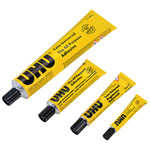
This is the glue most people picture when they hear the word UHU. UHU All Purpose Adhesive is a clear, PVA-based glue that goes touch-dry in sixty to a hundred and twenty seconds and reaches full strength after about twenty four hours. It bonds wood, ABS and PVC plastics, polystyrene, metal, glass, ceramics, leather, rubber, fabric and paper, covering most of what sits around a typical home or school desk. It won't bond Styrofoam, polyethylene or polypropylene, so check what you're holding first. It's moisture-resistant rather than fully waterproof, and because it contains solvents it's flammable, so keep it away from open flames while it cures.
UHU Max Repair: When the Job Needs More Muscle
UHU Max Repair is the step up from the all purpose tube: an extra strong, elastic, gap filling adhesive that cures fully waterproof and dishwasher safe, good for mugs, plant pots, garden ornaments and anything knocked around outside. It works from minus fifty to plus one hundred degrees Celsius, resists UV light, and reaches around 490 N per square centimetre once cured. It bonds porcelain, ceramics, most plastics, metal, wood, glass, leather, rubber, Styrofoam, paper and card, though not polyethylene, polypropylene, PTFE or clothing, so for fabric repairs use the textile glue below.
The real difference: All Purpose suits quick, everyday jobs that stay dry and indoors. Max Repair survives water, heat, cold, sunlight and the dishwasher, and fills gaps rather than just a thin bond line. If the repair is going outside, in the kitchen or the bathroom, Max Repair is the safer choice.
UHU Super Glue: For Fast, Small, Precise Fixes
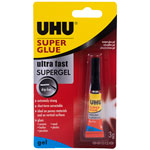
Is UHU glue the same as superglue? Not exactly: UHU is the brand, and "super glue" describes a chemistry (cyanoacrylate) that sets almost instantly. UHU makes genuine cyanoacrylate super glue too, sold as UHU Super Glue Easy Fluid and a flexible gel version. Grab these for a snapped phone case, a lifted shoe sole edge or a small ceramic chip, anywhere you need an instant, precise bond rather than a gap filled. It skips the harsh fumes older cyanoacrylate glues are known for, comes in fully recycled, plastic-free packaging, and gives an adjustable fifteen to twenty second window before it grabs. Once cured the bond is water-resistant and dishwasher safe, and the Flex Gel version stays flexible and won't drip on porous materials like fabric.
UHU Epoxy: Maximum Strength, Full Waterproofing

For jobs where nothing else will quite do, there's the UHU epoxy range. UHU Epoxy Ultra Strong is a two part adhesive mixed in equal amounts, reaching up to 170 kg per square centimetre once cured, serious holding power for ceramics, stone, glass, metal and wood. UHU also sells an Epoxy Putty kneaded by hand to fill holes and gaps, which cures even underwater, and a 5 Minute Syringe for a strong bond in a hurry. The cured adhesive handles roughly minus forty to plus one hundred degrees Celsius (the Syringe tops out around plus eighty), is fully waterproof, chemical resistant, and paintable.
Can UHU glue be used outdoors, and is it UV resistant? For Max Repair and the epoxy range, yes, both handle UV exposure and temperature swings, so garden furniture and outdoor ornaments are fair game. All Purpose Adhesive isn't built for permanent outdoor exposure, so for anything living outside long term, Max Repair or an epoxy is the better call.
UHU Textile Glue, Contact Glue and the Craft Stics

UHU Textile Glue is solvent-free and dries transparent and flexible in around thirty minutes, so it won't go stiff or crack at a seam. Once cured it's washable up to 90 degrees Celsius and dry-clean safe, and a warm iron speeds up curing. It's built for fabric, felt and leather, useful for hems, patches and small leather goods rather than just a school supply.

UHU Contact Glue Liquid is a different animal again, a neoprene rubber contact adhesive, moisture and frost proof, rated minus fifteen to plus seventy degrees Celsius, for shoe soles, bag straps and rubber repairs. Apply a thin layer to both surfaces, let them go tacky (not wet), then press firmly together; rush that step and the bond is noticeably weaker.
Finally, for paper, card, photos and school craft, there's UHU Stic, a solvent-free, washable, acid-free glue stick safe for kids, alongside UHU Arts and Craft Glue for bigger jobs. UHU's stick range also includes a ReNature version, with a body made from renewable plant-based material and an adhesive roughly ninety eight percent natural ingredients including water, a useful option if you want less fossil-based plastic without giving up a stick that works.
Is UHU glue toxic, safe for skin, or flammable?
UHU's PVA glues, textile glue and craft stics are solvent-free or low-solvent and safe for everyday handling, including by children for the Stic range. The super glue and epoxy ranges are stronger chemistries that bond skin almost instantly, so work in a ventilated space. All Purpose Adhesive contains solvents and is flammable while wet, so keep it away from flames until cured; the epoxy, super glue and textile ranges aren't flammable the same way.
Is UHU glue waterproof, and how strong is it?
This depends on which UHU you're using. All Purpose Adhesive is moisture-resistant rather than fully waterproof. Max Repair, the epoxy range and Super Glue are all waterproof or water-resistant once cured, with Max Repair and epoxy also dishwasher safe. Max Repair reaches around 490 N per square centimetre and the epoxy range up to 170 kg per square centimetre, well into "will outlast the object you're repairing" territory.
Is UHU glue vegan? What's a substitute, and where is it from?
UHU doesn't market its adhesives as vegan-certified, but the core PVA, epoxy, super glue and textile formulas are synthetic, not animal-derived. UHU is a German brand, headquartered in Buhl in the Black Forest, still manufacturing most of its range in Europe. If you can't get the specific product for a job, the honest substitute is another adhesive on the same chemistry: a PVA for paper and wood, a cyanoacrylate for instant bonds, or an epoxy for strength and gap filling.
How do you remove UHU glue from skin, hands or clothes?
For PVA-based UHU glue on skin, warm soapy water and gentle rubbing lifts it once dried; on fabric, soak in warm water before washing. For Super Glue or epoxy on skin, don't pull bonded skin apart; soak it in warm soapy water and peel apart once the glue softens, and acetone-based nail polish remover can help, used sparingly and never near eyes. On clothes, treat cured super glue or epoxy as a stain and work from the back of the fabric with acetone, tested on an inside seam first.
Whichever job you're tackling, the UHU range has a specific product for it rather than one glue trying to do everything badly. Browse the full lineup on our UHU glue collection and match the product to the material and the conditions it needs to survive.
